02. "[ˈbuːʒuː]"
Introduction
The name of this project comes from a word my son says among his panoply of semi-made up words (I can show you a video in class if you'd like). The relationship to the project is that you will make-up or research a context (fictional, historical, or otherwise) for a set of glyphs that you will use to create ephemera and communicate with someone else in class.
This will be in order to continue to think about the linguistic context of our work, as well as to still create an aeshthetically and logically consistent visual system of some kind but with slightly lower typographic stakes as it will be non-Latin.
Thus, what I ask you to do is to be creative (i.e. "make up glyphs") in order to further your understanding of type design, the related program(s), and the related language which type is but on substrate.
Objectives
- Gain greater agency and proficiency with your type design software of choice.
- Continue to center your type design practice on the core concepts of "the truths", keeping in mind creating visually consistent systems.
- Apply your newfound and growing type design skills to a conceptually consistent end.
Final Deliverables
- A .TTF or .OTF file with at least 8 glyphs from your chosen or bespoke system.
- "A specimen sheet" showing all the characters and what concepts they are mapped to. This should be at least 11 x 17in.
- 8 pieces of ephemera or roughly equivalent (see below).
- language exchange ephemera (at minimum) an 11x17in. poster showing the evidence of your communication with someone else in the class (pairs will be chosen randomly).
- A folder with all your process work sketches, screenshots, and notes
Requirements/Clarifications for Deliverables
-
All the above, should be printed out/rendered/linked for class and uploaded digitally to your folder for the project This is for grading and archival purposes.
-
Your "main"/required 8 glyphs must be mapped to the "home row" keys (ASDFJKL;). They can either drawn in those spaces or through contextual alternates (you will learn how to do this). Additional glyphs can be related to any other keyboard key you'd like.
-
Your glyphs should be "appropriately complex" I need to make sure people are using Glyphs/Font Forge/Fontra at an appropriate level. So I assume your characters will be more complext than simple geometric primitives (ie built in ellipses or rectangles). If you have a reason to do this or are curious if your system is complex enough we can discuss that.
-
For the other ephemera By this I mean, I am assuming 8 * (11 x 17in.) AT LEAST. Which would be (very) roughly equivalent to 2 * (24 x 36in.) or say a 32 page zine where each page is half letter (5.5 x 8.5in.) This is mainly so that you have to extrapolate your idea visually, if you want to do something else, say motion graphics, or a website, a virtual reality piece, please run it by me.
-
Your language exchange (more info) You will be paired with someone else in class to communicate in your given system and produce some kind of aesthetic residue of that communication. This could be something like:
- A series of photographs of you and the other person exchanging flash cards showing the glyphs, what you communicated, and what it means.
- Hand written notes with the other person showing your exchange.
- A text exchange with the system installed as a typeface.
- A video where you speak in the system and show subtitles in multiple languages (ie your system and rough english translation)
-
Your language exchange will ultimately be one for each person. That is to say, whoever you are paired with, you will work with them to communicate in their system, and them in yours. Then you will produce ephemera. You can divide the labor of the exchange poster or ephemera in any way you wish (ie you decide someone who is better at taking pictures to do the photography, you do the posters for the other person's system, you both do half and half in some way).
Initial Steps (fictional)
-
Think of a Context → It could be what pass as humans 10,000 years in the future, it could be you sad at White Plains train station 2 years ago, it could be a fictional universe where tube people emit smoke in an endless desert but consider a context. Think of what the beings who inhabit this context are like, and how they express themselves, and what they might need to communicate, and with what level of urgency.
-
Think of a Means → Now consider a means by which the folks from those context would communicate with each other. Smoke signals, lights, sticks on sand, ink on papyrus, elaborate text emoji collages?
-
Think of Concepts → Think of at least 8 concepts that you might need to express given your context. What might one need from another being in this context? How would they acquire it? Over what distance might this communication take place? Would the communication be one-to-one, one-to-small groups, one-to-many, many-to-many? A helpful idea might be to consult someting like the Swadesh List(s), a list of words that are thought to be universal.
-
Think of a System → How do the context, means, and concepts influence each other? For example:
- human beings living near bodies of water for agricultural reasons, might conceive of using paper and ink or incising in wet clay for tracking information, whereas
- people communicating over greater distances might use flags, or smoke, and need to communicate more urgent messages.
- an imagined person 10,000 years in the future might have some kind of neuralink that allows them to perceive and understand ideographic languages with a different level of precision or intimacy.
- you waiting at a White Plains trainstation might conceive of a series of dust drawings with some kind of communication like the "hobo alphabet" that relate to where it is safe to wait, what shops are open at what times, etc.
Initial Steps (historical)
I can imagine the above description being overly abstract, or perhaps unhelpful. Here's another way to approach that is research-oriented in a more specific way, or maybe helpful if you don't immmediately have an idea
- Think of, or find, a (historical, non-Latin) Context → Think of a culture that you are interested in, know vaguely about from a history class. This might be semaphore flags, an older version of the Chinese writing system, the history of a language you use at home. Look at the resources below as well if you're unsure. Choose a system that is not fully solved, or that you are extending in some way.
- Think of a Means → How was this actual language communicated? With pens? With sticks in clay? With flags? With smoke?
- Think of Concepts → What historical events might have influenced what these people would talk about? Trade? War? Art? Use research or resources like the Swadesh List (linked below) to extend this. What new things might an older language need to communicate, why, and how?
- Think of a System → Think of how digitization benefits or changes this communication? What common shapes forms or arrangements appear repeatedly in the writing you've seen.
Considerations
- The meaning can be ambiguous → The meaning does not need to map one-to-one to a single symbol, or can have multiple or contextual meaning. For example you might have a symbol that means "tall" but arranged a specific way might mean "leader" (ie person above others hierarchically)
- Use it to explore other things you are interested in → A system with no, or infinite genders? A system where "blackness" in terms of skin color and "blackness" like visual darkness are separate and distinct concepts? Go for it.
- The glyphs do not need to be ideographic or pictographic → We will talk about other writing systems in class.
- It cannot simply be another alphabet → Hopefully this is obvious. You cannot simply just map A = new symbol, B = new symbol, like Aurabesh in the Star Wars universe (mostly a different alphabet).
- You might want, for class, to remain secretive → If there is some reason, for class, you do not want to reveal the exact meaning of what you are saying please let me know that is the case, however please elucidate your thinking via the files you upload.
No Shuriken Mode Challenges
(This is where "no shuriken mode" comes from)
(These do not guarantee a better grade, they are merely suggestions for what might be a superlative project, or a jumping off point if you're not sure what to do technologically)
- Devise another mode of expression for your glyphs and then use it to communicate in class. For example, come up with a spoken component, and speak with someone else in class (fine if it is from a script/pre-rehearsed).
- Create a Muzzy or Rosetta Stone-like device for your glyph/language system. That is to say, consider a means written, video, or otherwise where someone who speaks English could gain some understanding of the system that you created. Below is a commercial for the product called Muzzy.
- Use contextual alternates to create or simulate different character arrangements (ie the character for "tall" is distinct and the glyph for "person" is distinct but if "tall" is on top of "person" it might mean "leader" rather than "tall person")
- Extend the set of characters in your system, to 12 or 16 or 20, thinking about subtler expressions of concepts, ways to describe things, etc.
Grading Criteria
| Criterion | % |
|---|---|
| All work is uploaded to the proper folders | 10% |
| All work is ready for class discussion(s) | 10% |
| Digital craft is at an appropriate level | 10% |
| Exploration of Glyphs/Font Forge/ Fontra is appropriately thorough | 10% |
| Process is clear and thoroughly documented | 10% |
| Language Exchange shows thorough/effective collaboration | 10% |
| Relative strength of concept | 20% |
| Relative strength of execution/"follow-through" of concept | 20% |
Resources / Related Work / Inspiration
-
Swadesh List(s) → A list of concepts that are thought to be "universal".
-
Unicode Charts → All the different languages, writing systems, and character sets in Unicode, the way writing is represented in code by most computer systems.
-
Script Encoding Initiative → In their words "(SEI) advances the digitization of the world’s writing systems, from ancient inscriptions to newly invented alphabets. SEI offers technical guidance and produces research on scripts, standards, and society in today’s digital world."
-
Forgetten Scripts .pdf from Archive.org → A book from 1968 looking at deciphering texts that are, perhaps more well-known today such as through the Rosetta Stone or Sumerian, and Egyptioan.
-
Endangered Alphabets → A website with some documentation on scripts and alphabets that are not widely used.
"brainfuck" is an "esolang" or a esoteric programming language, intended to be cumbersome to use. It is not for pragmatic, or business purposes (like say COBOL, COmmon Business-Oriented Language expressly is.). Bodyfuck uses computer vision to analzye motion and the body shape to interpret the user's body as the brainfuck language.
A really interesting project on taking Maya Hieroglyphs and converting them to a contemporary typeface.
Past Student Work
I have administered this project as a much shorter exercise called "Imagined Genesis" in the past, with less precise terms. I have also done a project that I have called "Unicode Spelunking" which I have semi-folded into this project. Here are some examples from both. As such not all these examples necessarily are meant for inspiration and not as an example that would totally fulfill this specific assignment.
"Imagined Genesis" Examples
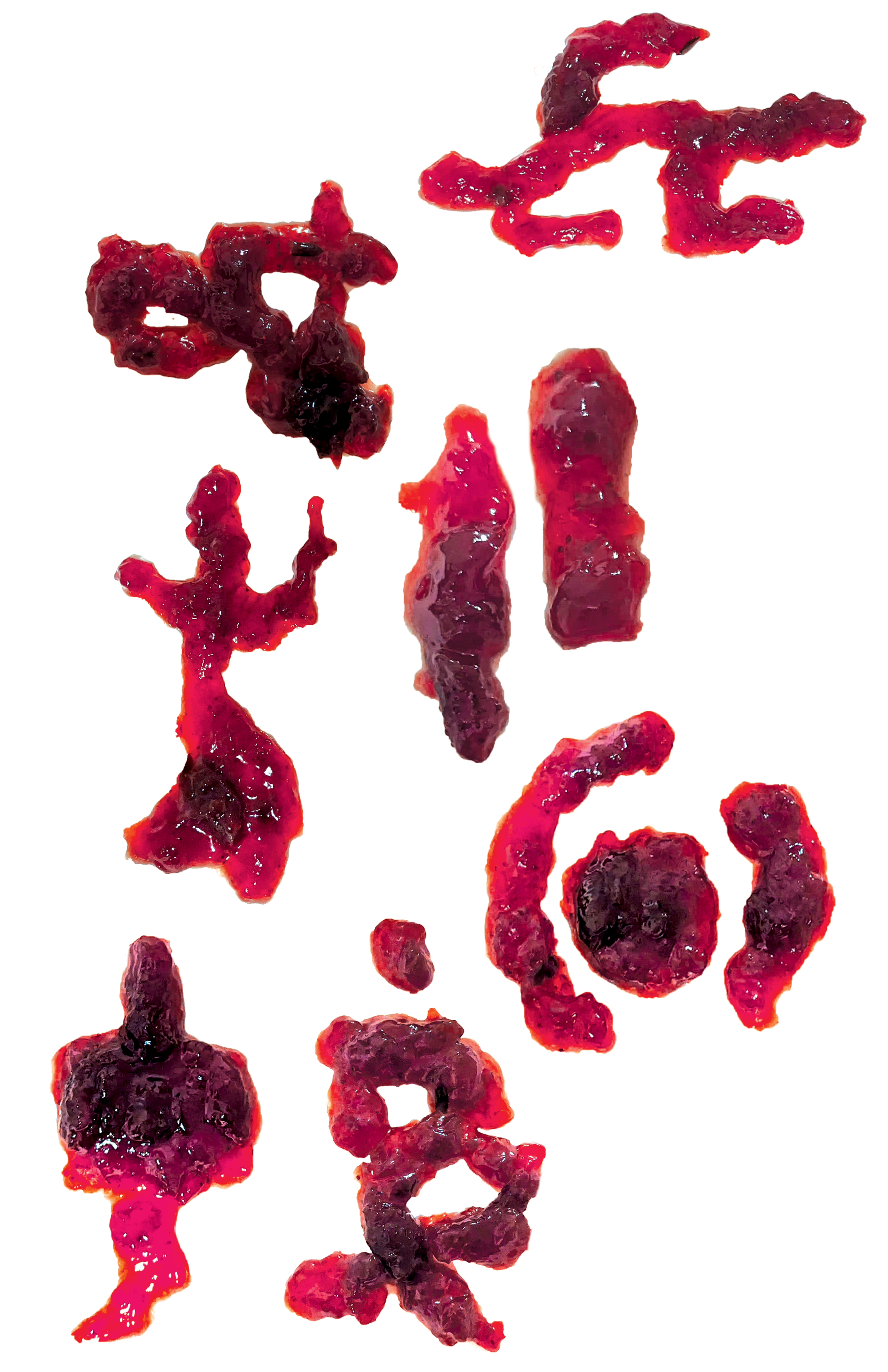
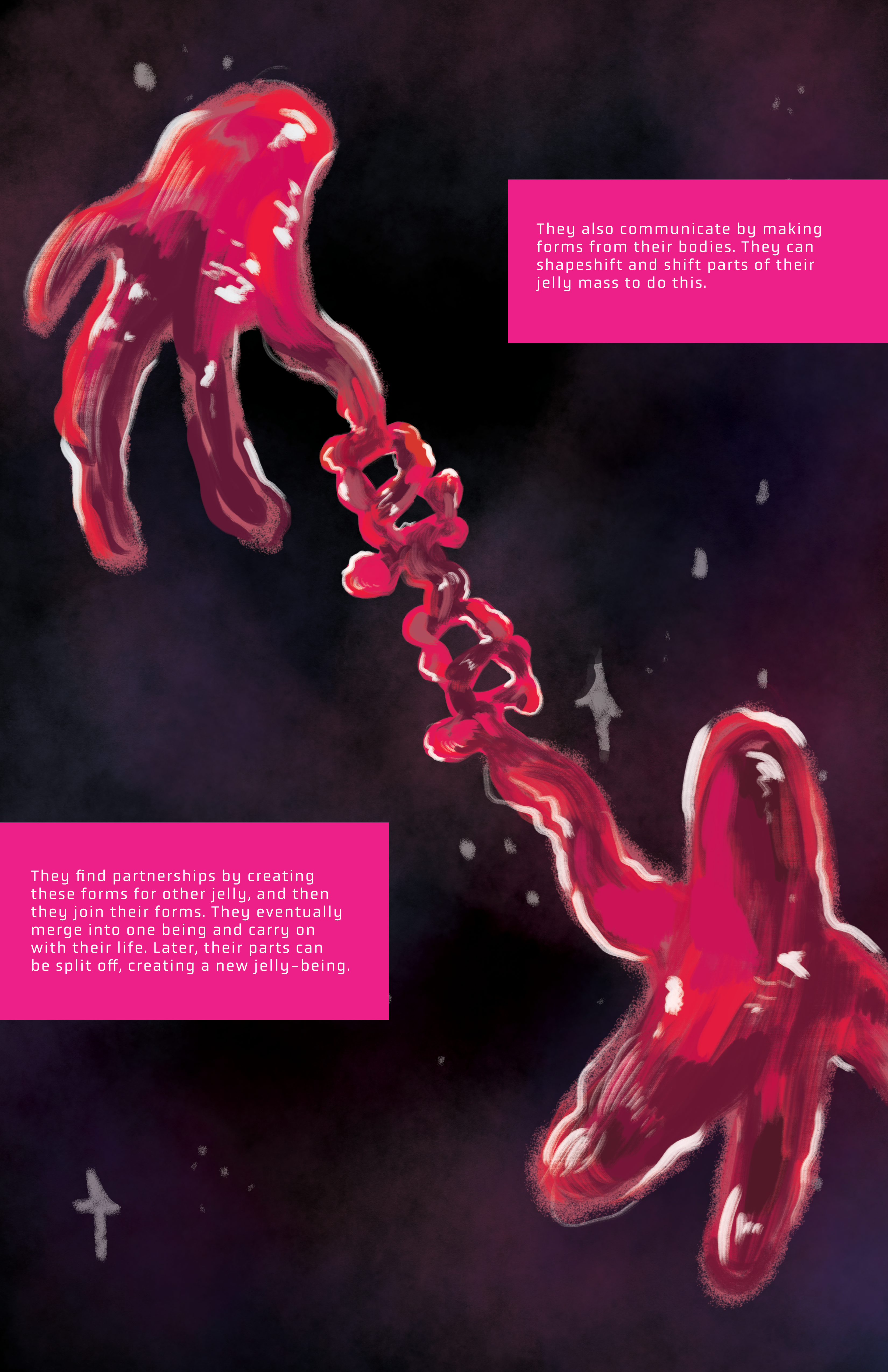
Julia Ettkin, Spring 2024, "Jelly Universe"
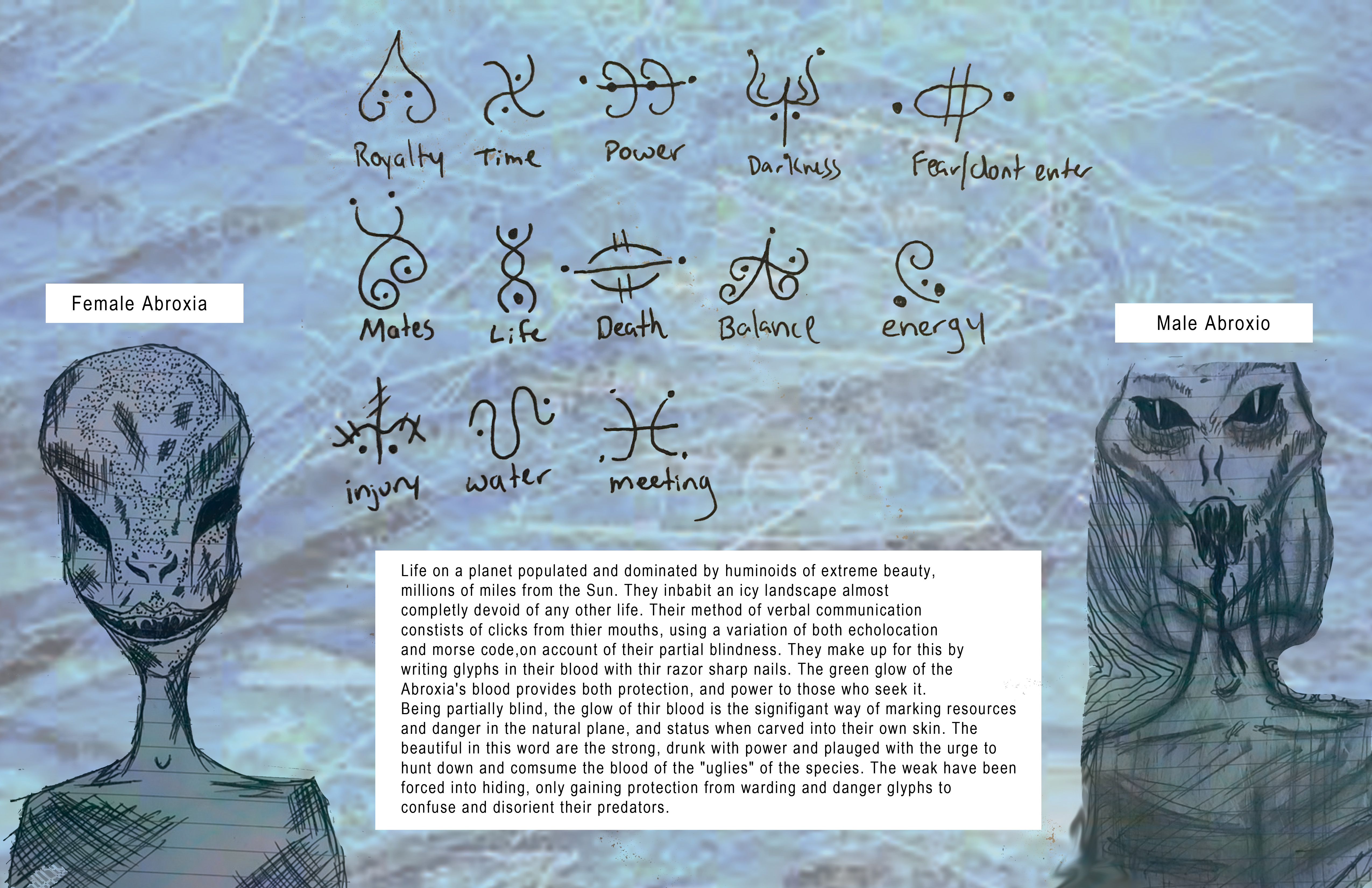
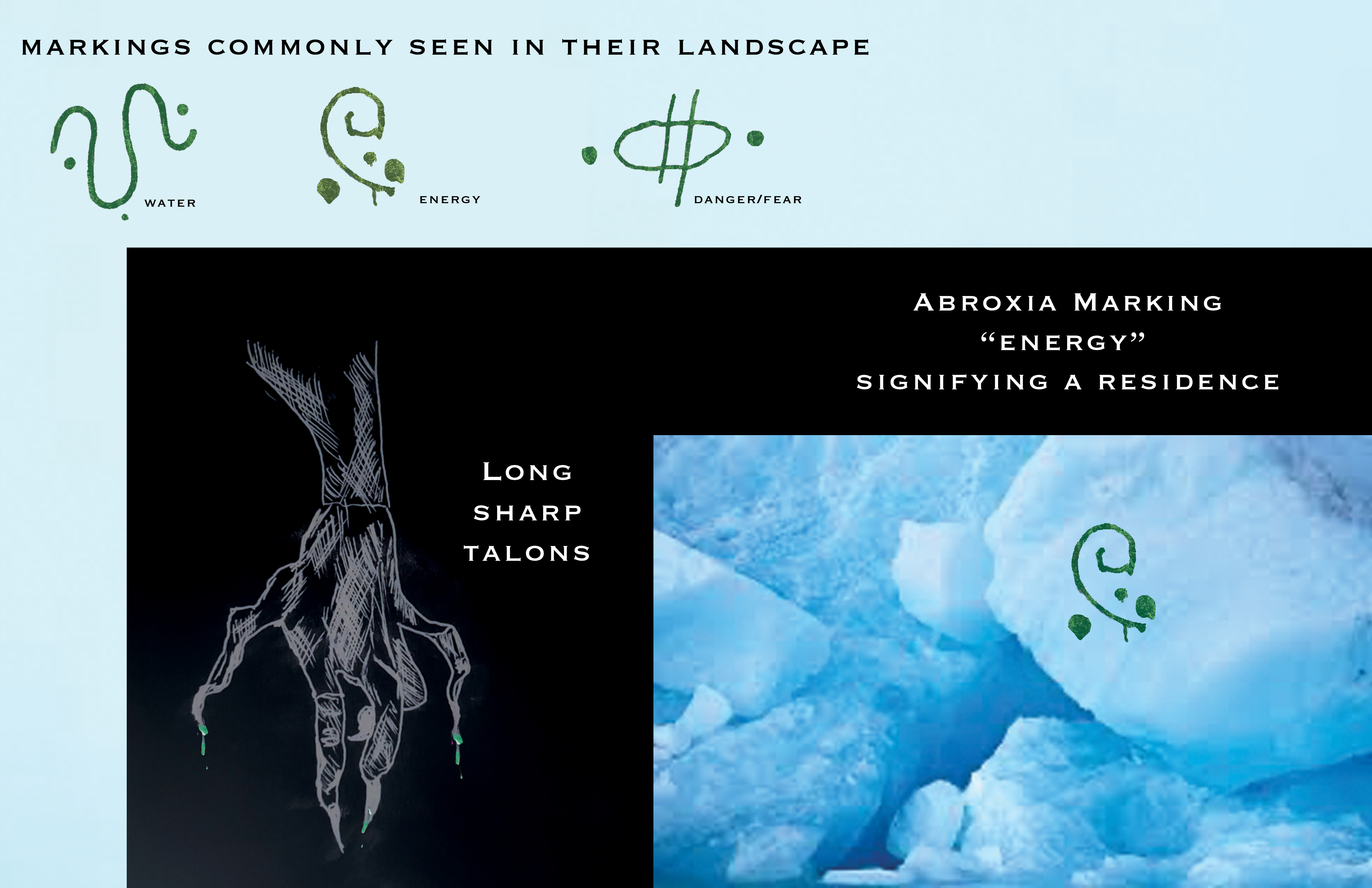
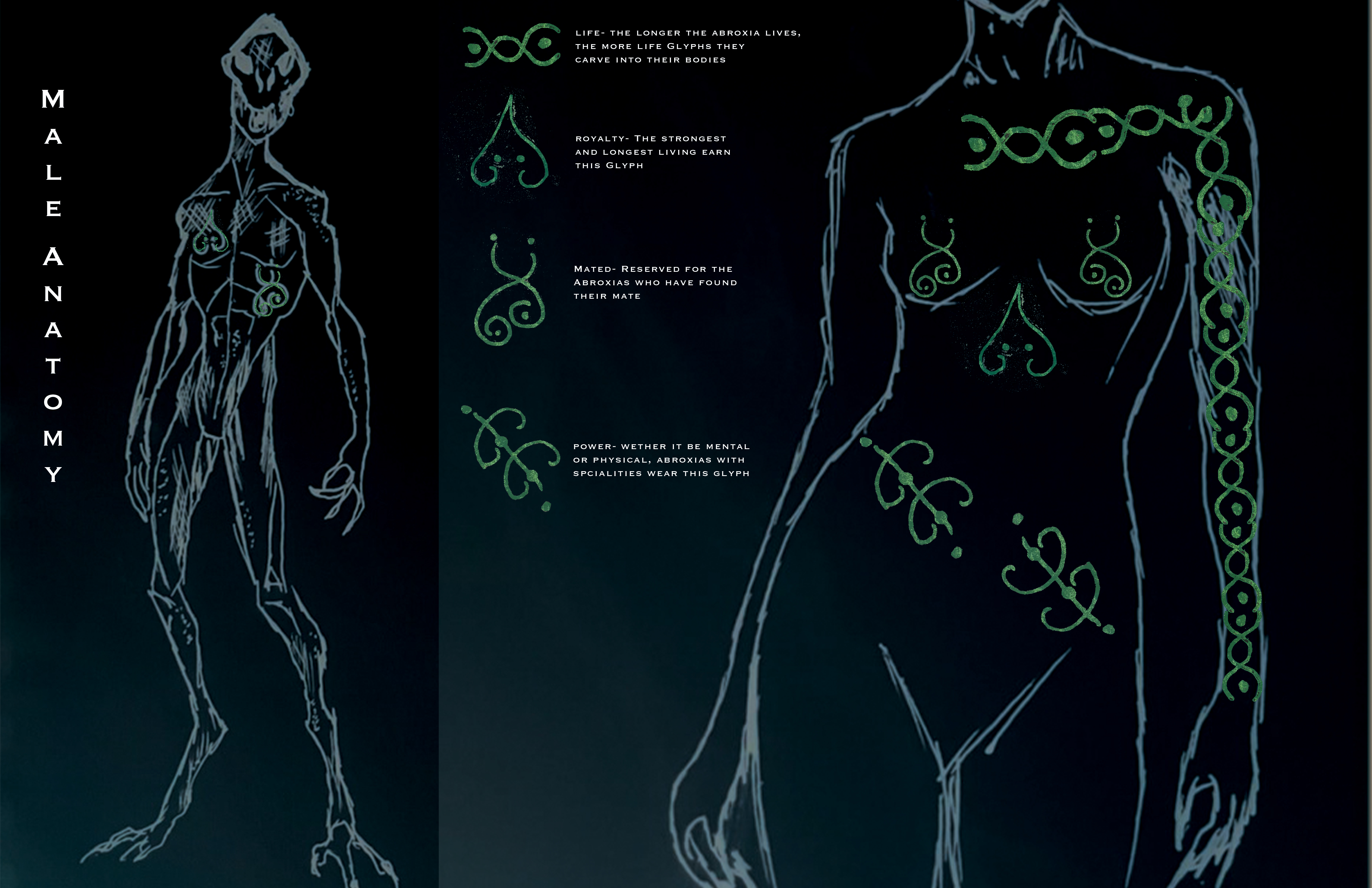
Cyrene Moore, Spring 2024, "Abroxia Markings"
"Unicode Spelunking" Examples
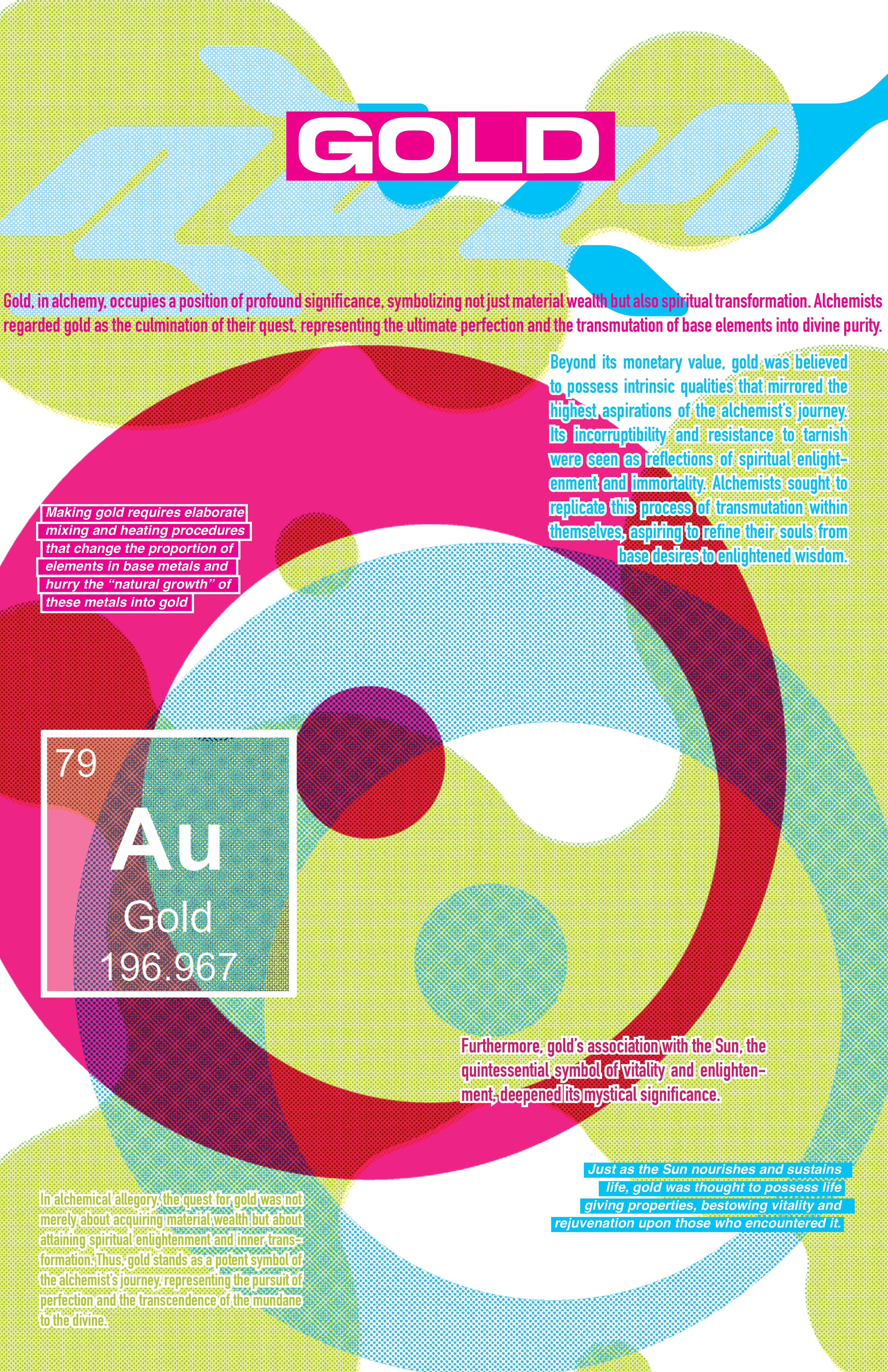
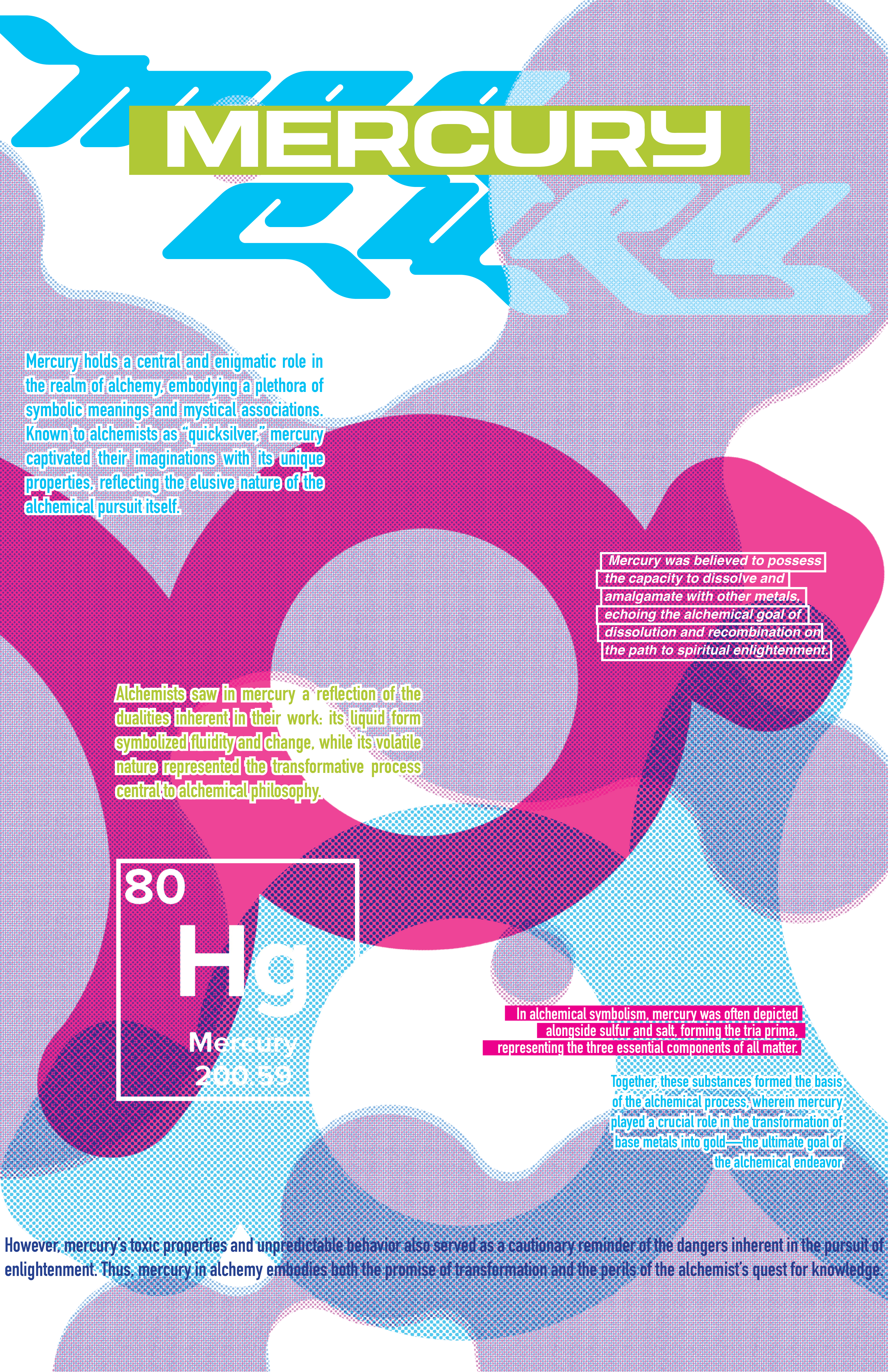
Gabi Soares, Spring 2024, Alchemical Symbols
Nicholas Beltran, Spring 2024, Filipino Babayin writing system


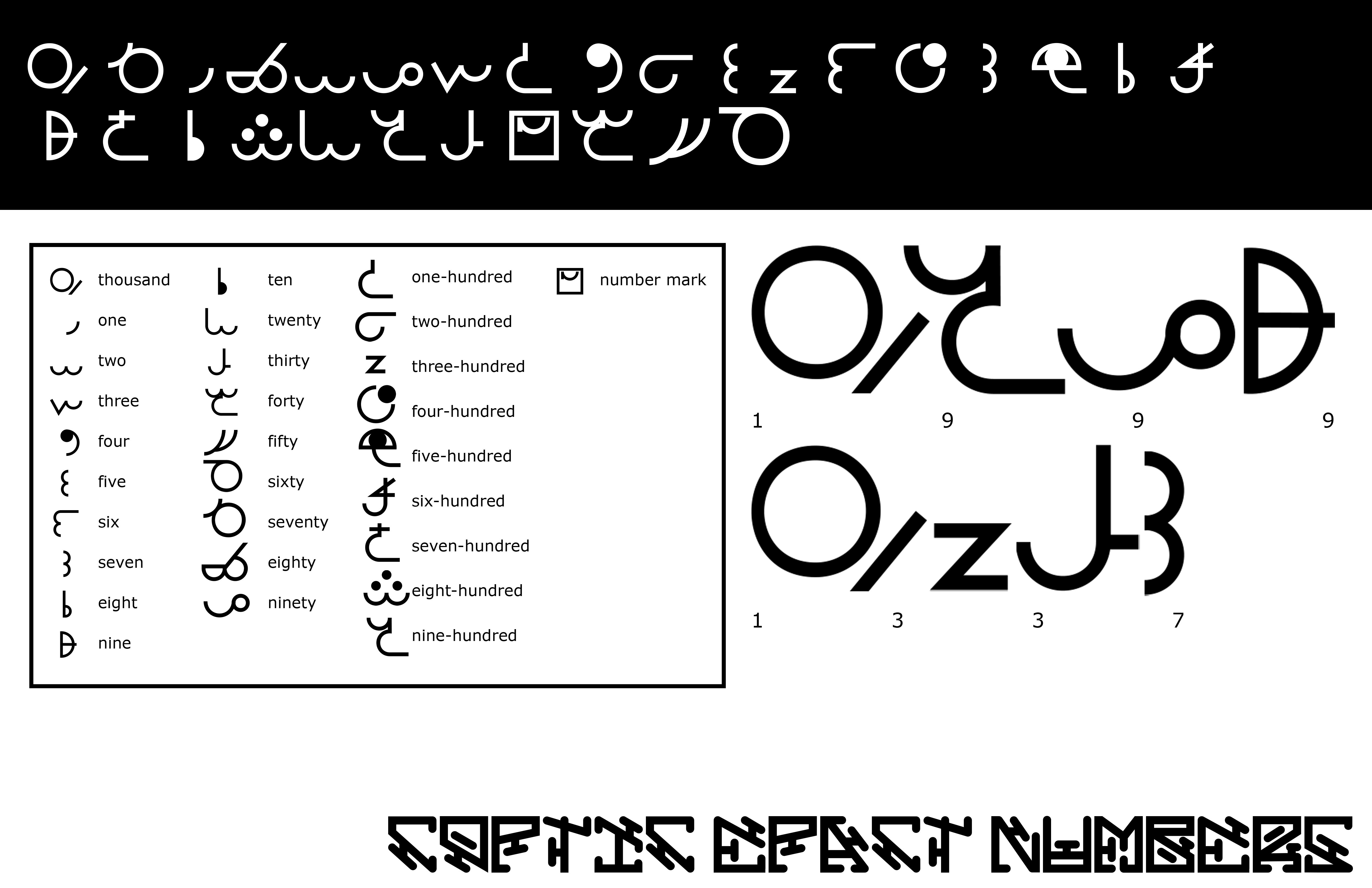
William Rogers, Spring 2023, Coptic Epact Numbers
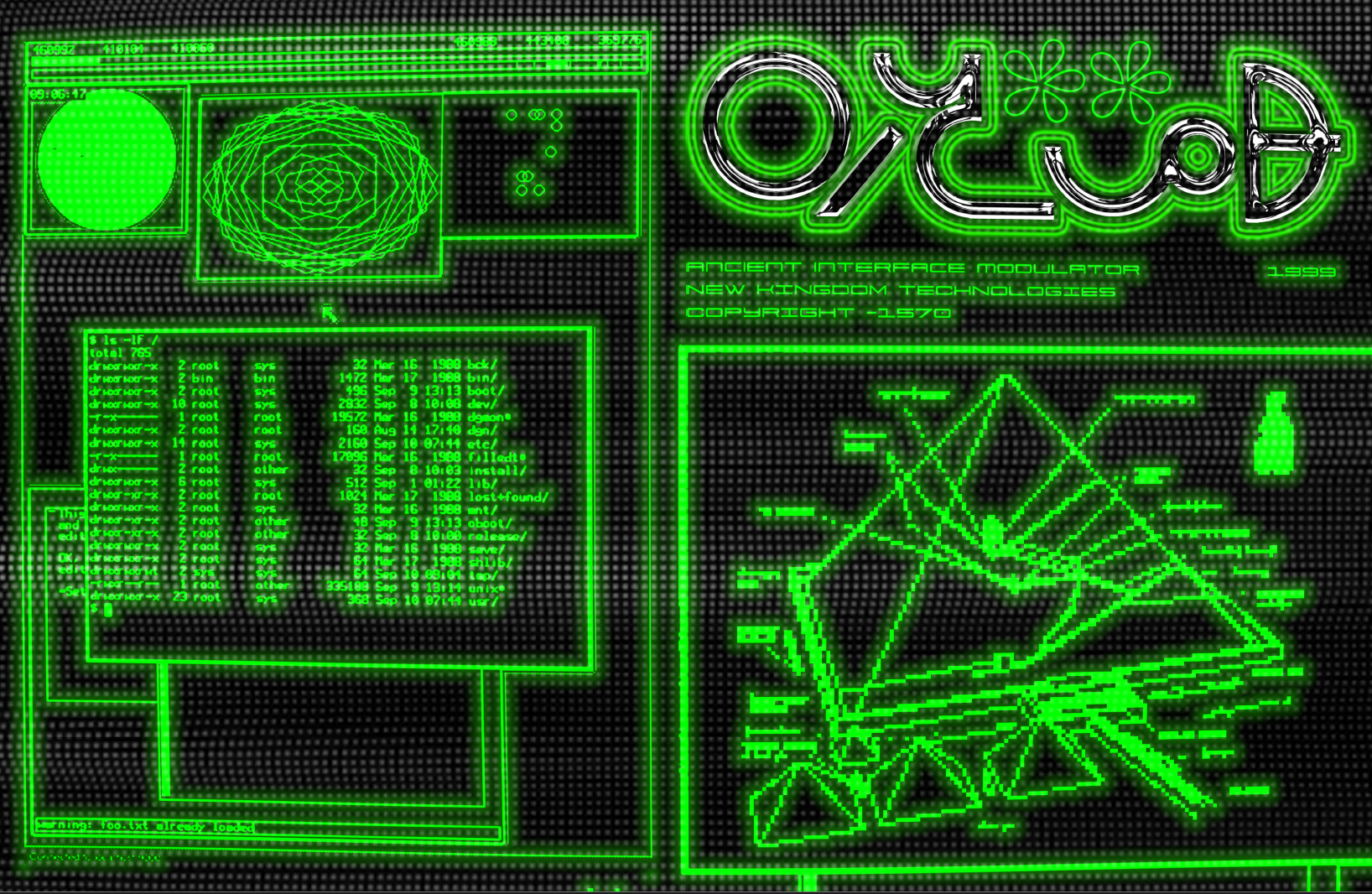
Peter Gieryic, Spring 2023, Runic "Sharp"
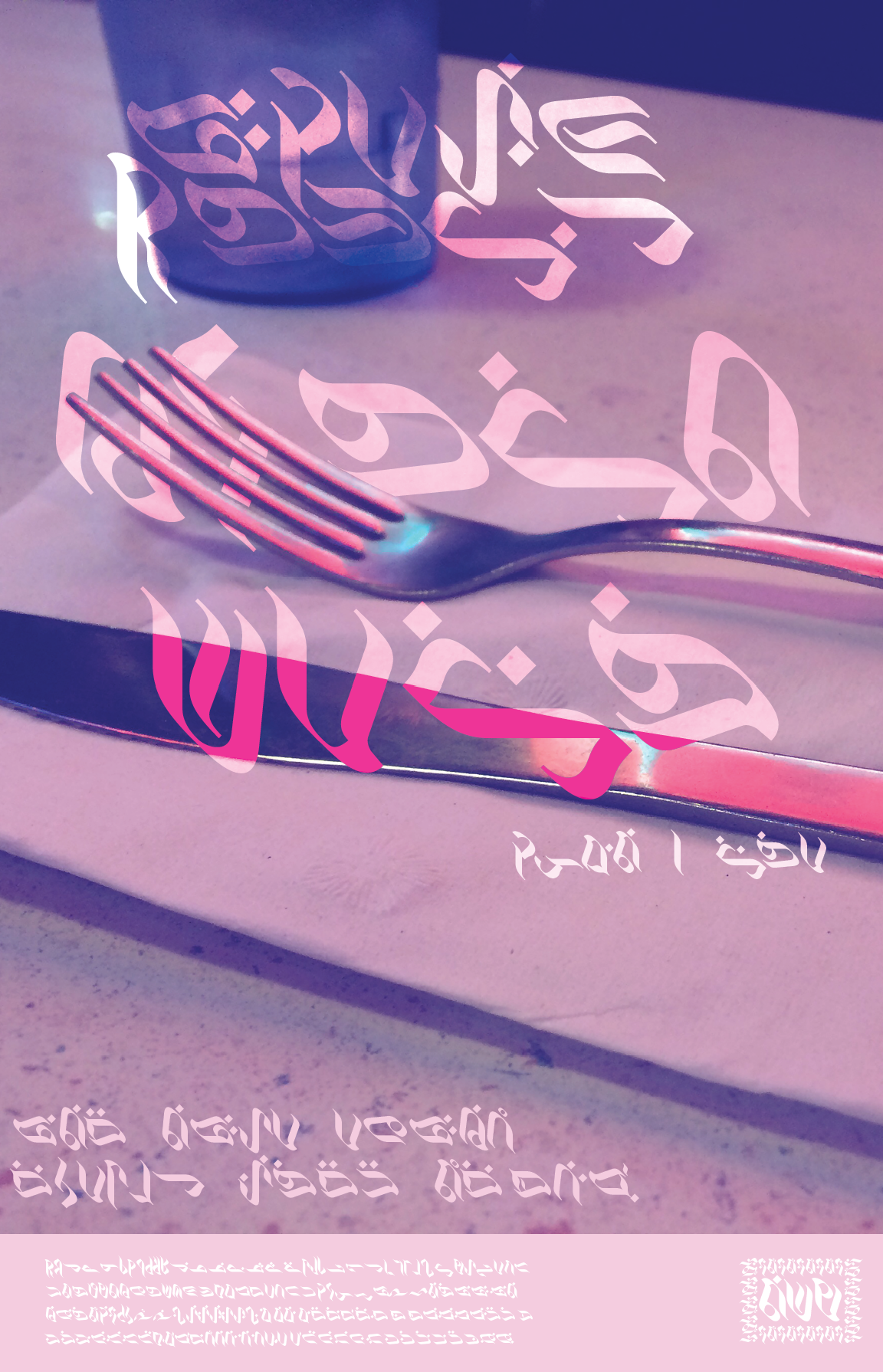
Gwenola Corbett, Spring 2021, Canadian Aboriginal writing system
Relevant Dates
-
02/03/2026 →
- In Class → Introduction
- Homework → Begin ideation / sketches / research
-
02/10/2026 →
- In Class → Review progress (one-on-one), and in-class work time
- Homework → Continue, work on glyphs, respond to feedback
-
02/17/2026
- In Class → In-progress critique, assign linguistic exchange
- Homework → Prepare work for in-progress critique
-
02/24/2026
- In Class → Review progress (one-on-one)
- Homework → Prepare work for critique
-
03/03/2026
- In Class → Critique and writing assignment
- Homework → Work on writing assignment and resubmission (optional)
-
03/10/2026
- In Class → Review written responses and resubmissions
- Homework → Confirm all work is uploaded